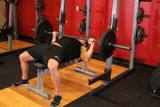
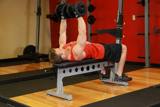
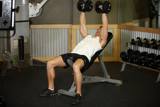
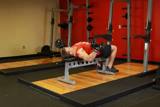
Decline Dumbbell Bench Press tutorial
The decline dumbbell bench press is performed on a negative-angle bench, pressing dumbbells up from the sides of the chest. This angle emphasizes the lower chest and places less stress on the front shoulders. Dumbbells allow a greater range and independent work for each arm, suiting beginners to intermediate lifters.
How to perform
- Set the bench to a 15 to 30 degree decline and lock your feet under the pads.
- Sit with the dumbbells on your thighs, bring them to your chest and lie back.
- Hold the dumbbells over your lower chest with straight arms.
- Retract your shoulder blades and lower the dumbbells slowly to the sides of your lower chest.
- Keep your elbows at about 45 degrees to your torso.
- Press the dumbbells up by squeezing your chest, and at the end of the set bring them to your chest and sit up with control.
Breathing: Inhale as you lower the dumbbells and exhale as you press.
Key tips
- Bring the dumbbells slightly together at the top without clanking them.
- Avoid a steep decline so blood doesn't rush to your head and control is maintained.
- Keep your wrists straight and stacked over your elbows.
Common mistakes
- Flaring the elbows to 90 degrees, stressing the shoulders
- Dropping the dumbbells quickly without control
- Dropping the dumbbells to the sides at the end of the set
Safety: People with high blood pressure or shoulder problems should be careful and can use a flat dumbbell press or assisted dips instead.
Suggested sets and reps
Beginner3 sets × 8–12 reps
Muscle mass4 sets × 6–12 reps
Strength5 sets × 3–6 reps
Fat burning3 sets × 12–15 reps, short rest
Pick a weight where the last 1 to 2 reps are hard but done with correct form.
Get a complete workout program
Do this exercise within a personalized program based on your goal and level.
Get a free program